


If you've ever held a precision part like a medical device component, aerospace fastener, or small automotive connector, you've likely interacted with work that started life on a CNC swiss lathe. As a supplier who's spent years troubleshooting, optimizing, and fine-tuning these machines for our customers, I've watched threading operations go from a finicky, error-prone step to one of the most reliable, repeatable processes in modern precision machining. What makes swiss lathe threading stand apart from turning on a standard lathe boils down to its core design: the guide bushing that supports the workpiece close to the cutting tool, eliminating the flex that ruins thread accuracy for small, slender parts.
To understand how a CNC swiss lathe performs threading, we first need to ground ourselves in what sets this machine category apart. Unlike conventional lathes that grip a workpiece at one end, Swiss style lathes (often interchanged with terms like CNC Swiss Turning or Swiss Type CNC Lathe) feed the bar stock through a guide bushing that holds it rigidly just millimeters away from the cutting tools. This rigid support is non-negotiable for threading, because threads require precise axial movement of the tool relative to the workpiece-any flex from a standard lathe's overhang would cause misalignment, inconsistent pitch, or damaged threads. Our team at AB, as a CNC swiss lathe supplier, has seen customers struggle with this gap for years before switching to Swiss Type Automatic Lathe models: parts that bent mid-thread, rejected 15% of production runs, or couldn't hold tolerances tighter than ±0.001 inches. Today, threading on a CNC swiss lathe is a streamlined, controlled process, but it's not just "pushing a button." It's a series of coordinated movements between the machine's spindle, tool turret, and control system that requires careful setup, tool selection, and program tuning.
Let's walk through the process step by step, starting with the fundamentals that make Swiss machining threading possible. First, every CNC swiss lathe threading operation relies on synchronized motion between two components: the main spindle that spins the workpiece and the tool turret that moves linearly along the Z-axis (the axis parallel to the bar stock feed). On conventional lathes, you use a lead screw connected to the spindle to drive the tool's axial movement, which limits flexibility for complex or small parts. On a CNC Swiss Lathe Machining setup, this synchronization is handled electronically via the machine's control system-no physical lead screw needed. The control reads the spindle's encoder signal (a sensor that tracks how many degrees the spindle has rotated) and sends exact, timed commands to the tool turret to move a precise distance along Z for each degree of spindle rotation. For example, a 1mm pitch thread requires the tool to move 1mm along Z every time the spindle makes one full 360-degree rotation. This electronic gearing is called "camming" or "spindle-sync," and it's what makes CNC Swiss Lathe threading far more versatile than manual or semi-automatic Swiss lathe threading.
Next, tool selection is a critical make-or-break step, one that many first-time Swiss lathe operators underestimate. Threading tools come in two primary styles for Swiss machines: single-point threading inserts and form-rolled thread tools (often called roll dies). Single-point threading is the most common for high-precision, custom threads, like those used in orthopedic implants. These inserts are made of high-speed steel or carbide, ground to match the thread profile-V-shaped, trapezoidal, or even custom metric or unified threads. The tool turret moves in a helical path along Z, dipping the insert into the workpiece on each pass to cut one "flank" of the thread per revolution. Roll threading, by contrast, uses two hardened steel dies that press into the workpiece as it spins, displacing material to form the thread. It's faster, more durable for high-volume runs, and produces stronger threads because it compresses the material rather than cutting it. We often advise customers that choosing between these two methods depends on their part: roll threading works best for soft materials like brass or aluminum for fasteners, while single-point is the only way to hold tight tolerances for medical or aerospace parts.
Once the tool is selected, the setup process begins, and this is where CNC Swiss Lathe Machining really shines for consistency. First, the bar stock is fed through the guide bushing and gripped by the main spindle, with the excess bar stock extending past the bushing to the cutting tools. Before threading, the machine will typically perform a facing and boring operation to create a smooth, flat surface where the thread will start-any burr or unevenness here will cause the threading insert to chip or the thread pitch to be off. Then, the control system loads the thread program, which includes specific parameters: pitch, depth of each cut, number of passes, and the start and end points of the thread. A common mistake we see new operators make is setting the start point of the thread too close to the main spindle, or too far from the end of the bar. The "thread runout" (the small unthreaded section at the start of the part) needs to be long enough for the tool to accelerate to full feed rate before it begins cutting, and the "thread relief" at the end needs to be long enough for the tool to decelerate so it doesn't crash into the part. On a standard lathe, this setup is done manually with trial cuts, but on a CNC Swiss lathe, it's programmed with precise coordinates, so you can run dozens of identical parts without adjusting.
One of the biggest advantages of CNC Swiss Lathe threading is its ability to do multiple operations in one setup, which reduces error and improves efficiency. For example, a part for a hydraulic valve might require turning a step, drilling a hole, and threading that hole all in one cycle on the Swiss lathe. Because the guide bushing supports the part during every operation, there's no need to re-grip the part in a second machine (a step that introduces alignment errors). The tool turret on most Swiss lathes has 8 to 12 stations, each holding a different tool-facing, drilling, threading, grooving-so the machine switches seamlessly between operations. We recently worked with a customer who was producing 10,000 medical valve parts on a conventional lathe, requiring three separate setups and resulting in a 12% rejection rate from misaligned threads. Switching to a Swiss Type Automatic Lathe cut that to less than 1% rejection, and reduced production time per part by 40%, all because the threading operation was done in a single, rigid setup.
But threading on a CNC Swiss lathe isn't without its challenges, especially when working with very small parts-think parts with a diameter less than 2mm, common in smartphone components or watch parts. The same guide bushing that provides rigidity for larger parts can sometimes cause friction or deflection for extremely small workpieces, so we work with customers to adjust the feed rate and spindle speed to compensate. Too high a spindle speed causes vibration, which leads to inconsistent thread depth; too low and the tool rubs, causing material to smudge and the thread to be out of spec. Coolant selection is another key factor: high-pressure, high-flow coolant is often used in Swiss machining to flush away chips from the thread groove, because chip buildup between the insert and the workpiece will cause the tool to gouge the thread. We've had customers try to use standard coolant systems from their old conventional lathes and run into constant chip-related thread errors, so we always recommend our customers invest in a through-tool coolant system for their Swiss lathes.
Another advanced feature that sets modern CNC Swiss Lathe Machining apart for threading is thread whirling, a specialized process used for large internal threads or threads on long, slender parts. Thread whirling uses a rotating head with multiple threading inserts that spin around the workpiece at high speed, cutting the thread in a single pass rather than multiple passes with a single-point insert. This process is ideal for long parts like medical guidewires or small shafts, where single-point threading would cause the workpiece to flex. While thread whirling is more specialized, many of the Swiss Type CNC Lathe models we supply have optional whirling heads, so customers can handle a wider range of threading applications without investing in separate equipment.
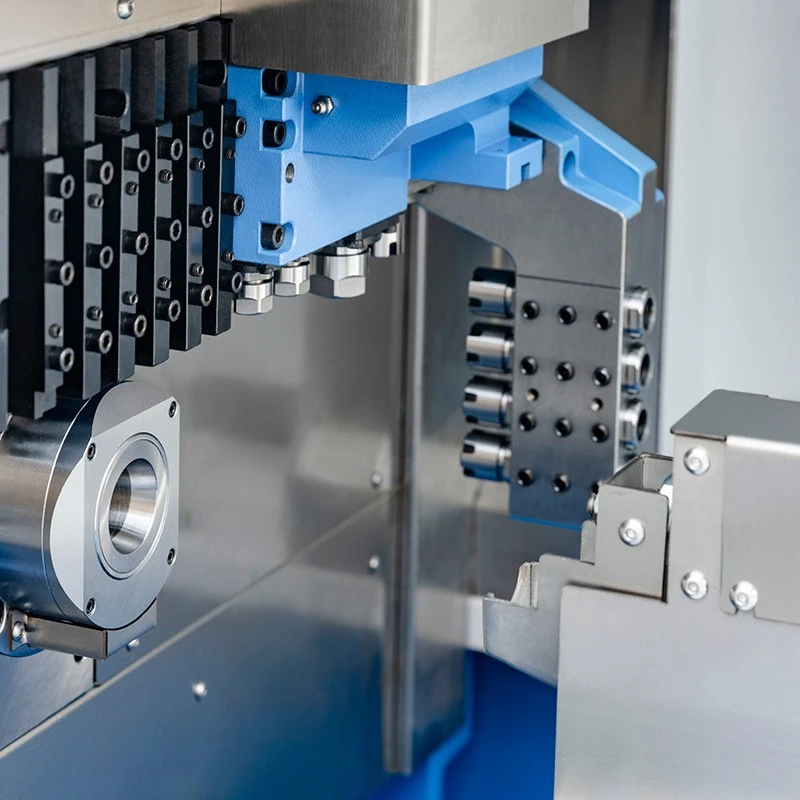

As a CNC swiss lathe supplier, I always emphasize that threading on these machines is not just a function of the machine itself-it's a combination of the machine's design, the tooling, the program, and the operator's expertise. The rigid guide bushing, electronic spindle synchronization, and multi-station turret make Swiss lathes uniquely suited for threading small, precise parts that conventional lathes can't handle. For customers looking to improve thread consistency, reduce rejection rates, or expand their part capabilities, switching to a Swiss style lathe is often the solution they need.
If you're working on a project that requires precision threading, or you're looking to upgrade your machining operations, we'd be happy to walk you through how our Swiss lathes can fit your needs. Whether you're producing medical components, automotive connectors, or aerospace fasteners, our team has the experience to help you optimize your threading processes. Get in touch with us today to discuss your requirements and learn how a CNC swiss lathe can elevate your production.
References:
- American Machinist. (2022). "Swiss-Style Lathes: Design and Applications for Precision Machining." Society of Manufacturing Engineers.
- Smith, J. (2021). "Threading Operations on CNC Swiss Turning Centers." Machining Science and Technology, 25(3), 412-435.
- DeGarmo, E. P., Black, J. T., & Kohser, R. A. (2020). Materials and Processes in Manufacturing (13th ed.). Wiley.
- Swiss Machine Tool Association. (2023). "Best Practices for Threading on Swiss Type CNC Lathes." International Manufacturing Technology Show.


