


As a leading supplier of universal lathes in China, ANTISHICNC has specialized in metalworking machine tool research and development for 28 years, providing over 12,000 machines to over 3,000 companies across turning and milling applications. We possess a deep understanding of the cutting characteristics of materials like steel and aluminum.Our machines utilize high-strength alloy castings and imported precision spindles. Tested under 72 hours of continuous load, these machines maintain an accuracy of 0.001 mm. ISO9001 and CE certified, they offer a ten-year maintenance-free lifespan.We bring together experts from various fields to provide process solutions, supporting customized parameters and automation modules tailored to your workpiece, production capacity, and other requirements. You can initiate specialized R&D with just one machine. We also accept ODM/OEM collaborations and have served over 20 industry segments. We offer a closed-loop service encompassing equipment selection, installation and commissioning, training, and lifetime maintenance. Our four-step quality inspection system ensures zero defects. You can learn more about our products below. If you have any questions, please feel free to contact us.
-
![Traditional Lathe Machine]() Traditional Lathe MachineTraditional lathe machine Can perform internal and external turning, taper turning, end facing, and other rotary parts turning;
Traditional Lathe MachineTraditional lathe machine Can perform internal and external turning, taper turning, end facing, and other rotary parts turning; -
![Traditional Lathe]() Traditional LatheThe C6136D traditional lathe is a standard horizontal lathe with stable performance and comprehensive functions, designed for high efficiency and adaptability in daily machining. Featuring a compact
Traditional LatheThe C6136D traditional lathe is a standard horizontal lathe with stable performance and comprehensive functions, designed for high efficiency and adaptability in daily machining. Featuring a compact -
![Parrallel Lathe Machine]() Parrallel Lathe MachineThe C616-1D Horizontal Conventional Lathe is a classic, versatile, and practical machining tool widely used across industries such as machinery manufacturing, automotive components, and
Parrallel Lathe MachineThe C616-1D Horizontal Conventional Lathe is a classic, versatile, and practical machining tool widely used across industries such as machinery manufacturing, automotive components, and -
![Universal Lathe]() Universal LatheThe CW series universal lathes, with their flexible adaptability and stable machining performance, have become core machining equipment in industries such as machinery manufacturing, construction
Universal LatheThe CW series universal lathes, with their flexible adaptability and stable machining performance, have become core machining equipment in industries such as machinery manufacturing, construction -
![Large Lathe Machine]() Large Lathe MachineThe CW-E series horizontal lathes are high-performance, general-purpose large lathe machine designed to meet the demands of heavy-duty cutting, high-load performance, and machining a wide range of
Large Lathe MachineThe CW-E series horizontal lathes are high-performance, general-purpose large lathe machine designed to meet the demands of heavy-duty cutting, high-load performance, and machining a wide range of -
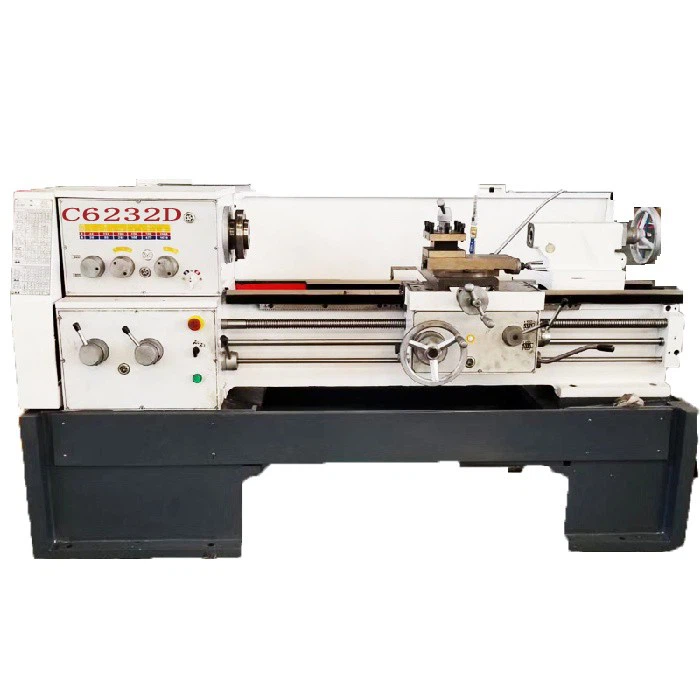
![Universal Lathe Stand]() Universal Lathe StandThe C6232D-750 universal lathe stand is a high-precision, versatile, general-purpose metalcutting machine widely applicable in machining, equipment maintenance, and training. With its rational
Universal Lathe StandThe C6232D-750 universal lathe stand is a high-precision, versatile, general-purpose metalcutting machine widely applicable in machining, equipment maintenance, and training. With its rational -
![7 Feet Lathe Machine]() 7 Feet Lathe MachineThe CA6140 series 7 feet lathe machine is a time-tested, classic, general-purpose turning machine designed for metalworking applications requiring stability, efficiency, and versatility. Whether mass
7 Feet Lathe MachineThe CA6140 series 7 feet lathe machine is a time-tested, classic, general-purpose turning machine designed for metalworking applications requiring stability, efficiency, and versatility. Whether mass -
![Lathe Machine 8 Feet]() Lathe Machine 8 FeetThe CA6240 lathe machine 8 feet series general lathes (A/B/C models) are highly versatile, robust, and offer excellent performance in metal cutting applications across a wide range of applications,
Lathe Machine 8 FeetThe CA6240 lathe machine 8 feet series general lathes (A/B/C models) are highly versatile, robust, and offer excellent performance in metal cutting applications across a wide range of applications, -
![Extra Heavy Duty Lathe Machine]() Extra Heavy Duty Lathe MachineThe CWZ series extra heavy duty lathe machine is a high-performance machine tool developed specifically for machining large and ultra-heavy workpieces. It is widely used in the energy, shipbuilding,
Extra Heavy Duty Lathe MachineThe CWZ series extra heavy duty lathe machine is a high-performance machine tool developed specifically for machining large and ultra-heavy workpieces. It is widely used in the energy, shipbuilding, -
![Heavy Lathe Machine]() Heavy Lathe MachineThe CWA61100 Heavy lathe machine is a high-performance machine suitable for machining shaft and disc parts made of various materials. Compatible with both high-speed steel and carbide tools, it
Heavy Lathe MachineThe CWA61100 Heavy lathe machine is a high-performance machine suitable for machining shaft and disc parts made of various materials. Compatible with both high-speed steel and carbide tools, it -
![Heavy Lathe]() Heavy LatheThe heavy lathe is a metalworking machine compatible with high-speed steel and carbide tools. It is suitable for machining shafts, cylindrical parts, and discs. It can perform external turning,
Heavy LatheThe heavy lathe is a metalworking machine compatible with high-speed steel and carbide tools. It is suitable for machining shafts, cylindrical parts, and discs. It can perform external turning, -
![Heavy Duty Metal Lathe]() Heavy Duty Metal LatheThe heavy duty metal lathe is a high-performance machine designed specifically for heavy-duty metalworking applications. It combines the stable structure of a traditional horizontal lathe with the
Heavy Duty Metal LatheThe heavy duty metal lathe is a high-performance machine designed specifically for heavy-duty metalworking applications. It combines the stable structure of a traditional horizontal lathe with the


Product Introduction
Our universal lathe machine is a versatile and widely used metalworking equipment. It is designed to perform a variety of turning operations on cylindrical workpieces. A universal lathe consists of key components such as a bed, headstock, tailstock, carriage, and tool post. They can process a wide range of materials and handle workpieces of varying sizes—from small rods to large shafts.
Product advantages
versatility
It can execute a wide array of machining operations—from basic turning and facing to more complex processes like threading, knurling, taper turning, and even light drilling or reaming—all on a single piece of equipment.
adaptability
It accommodates workpieces of varying lengths and diameters, from small precision components like bolts and bushings to larger shafts and cylinders, making it suitable for both prototype development and small-batch production.
user-friendliness
While capable of semi-automated operations, it also allows for manual control, enabling machinists to make real-time adjustments based on specific requirements.
cost-effectiveness
Their durability and ease of maintenance also lower long-term operational costs, as they require fewer specialized parts and can be serviced by a broader range of technicians.
Product Application
1. General Manufacturing and Prototyping
In general manufacturing, universal lathes are used to produce a variety of cylindrical or rotationally symmetric parts. This includes components like bolts, nuts, shafts, bushings, and sleeves, which are foundational in machinery, appliances, and automotive assemblies. They are also vital for prototyping, where small batches of custom parts need to be quickly fabricated to test designs.
2. Educational and Training Settings
Maintenance workshops, whether in factories, automotive garages, or industrial plants, rely heavily on universal lathes for repairing worn or damaged parts. Their ability to handle one-off repair jobs efficiently—without the need for mass-production setups—makes them invaluable in keeping machinery operational.
3. We are the largest Business expert
Technical schools, vocational training centers, and universities use universal lathes to teach basic machining principles. Their manual operation helps students understand core concepts like spindle speed, feed rate, and tool selection, laying the groundwork for advanced CNC machining skills.
4. Artisan and Custom Fabrication
Beyond industrial use, universal lathes are employed by artisans and hobbyists for custom fabrication. Metal artists create sculptural pieces or custom hardware (e.g., unique doorknobs or brackets). Their versatility allows for creative experimentation—machinists can combine turning with knurling (to add textured surfaces) or taper turning (to create conical shapes) to achieve unique designs.
5. Small-Scale Production for Niche Markets
Businesses serving niche markets (e.g., medical devices, musical instruments, or industrial tools) often use universal lathes for small-batch production. For instance, they might produce precision components for dental tools, tuning pegs for stringed instruments, or specialized fasteners. The lathe’s ability to switch between tasks quickly makes it feasible to produce diverse parts without retooling an entire production line, reducing overhead costs.
Precautions for use
Start and End with Cleanliness
Use a lint-free cloth to remove dust, metal chips, or coolant residue from the bed, carriage, and guide rails. Debris can scratch surfaces or jam moving parts, so clear them before powering on.
Use the right tools and materials
Match cutting tools to the workpiece material (e.g., carbide for hard metals) to reduce unnecessary strain on the lathe.
Follow the manual
Adhere to the manufacturer’s recommended lubricants, speed limits, and maintenance schedules—using the wrong oil or exceeding capacity accelerates wear.
Train operators
Ensure anyone using the lathe knows basic upkeep (e.g., cleaning after use) to prevent avoidable damage.
Product Components
Bed
A heavy, rigid base guiding all moving parts, with precision ways (flat or V-shaped) for slide movement, ensuring stability under cutting forces.
Headstock
Houses the main spindle, driven by a motor via belts or gears, to rotate the workpiece. It includes speed controls (levers/buttons) for adjusting spindle RPM and often has a chuck or faceplate for holding workpieces.
Tailstock
Mounted on the bed’s ways, opposite the headstock, to support long workpieces with a center (dead/live). It can also hold tools like drills or reamers for hole machining, adjustable along the bed for varying workpiece lengths.
Carriage
Slides along the bed, carrying tools. It has Saddle, Cross-slide & Compound rest.
Apron
Attached to the saddle, containing mechanisms (gears, clutches) to drive the carriage and cross-slide via the leadscrew (for threading) or feed rod (for automatic feeding), with handwheels for manual control.
Feed mechanism
Includes the leadscrew (for accurate threading) and feed rod (for power feeding of the carriage/cross-slide), controlled by levers to set feed rates (mm/rev or inches/rev).
Tool post
Mounted on the compound rest, holding cutting tools (turning, facing, threading tools) securely, often with a turret for quick tool changes.
Legs
Support the bed, elevating it to a comfortable working height and anchoring the machine to the floor for stability.
FAQ
Q: What materials can a universal lathe machine process?
A: Universal lathes are versatile and can handle a wide range of materials, including metals (steel, aluminum, brass, cast iron), plastics, wood, and some composites. The suitability depends on the material’s hardness and the machine’s power; harder materials like alloy steel may require higher torque and specialized cutting tools, while softer materials like wood need adjusted feed rates to prevent splintering.
Q: How to adjust the spindle speed on a universal lathe?
A: Spindle speed is adjusted via the headstock, typically using a gear lever system or variable speed controls (on modern models). For gear-driven lathes, shift levers to engage different gear combinations, which change the spindle’s RPM (refer to the machine’s speed chart for material-specific settings). Variable speed lathes use a dial or button to set speeds electronically. Always stop the machine before changing speeds to avoid gear damage.
Q: What causes workpiece vibration during turning, and how to fix it?
A: Vibration often stems from loose workholding (e.g., a poorly tightened chuck), unbalanced workpieces (especially long or irregularly shaped ones), dull cutting tools, or excessive feed rates. To resolve it: secure the workpiece firmly with chucks or centers; use a steady rest for long workpieces; sharpen or replace dull tools; reduce feed rate or adjust spindle speed to match the material.
Q: Can a universal lathe perform threading, and how?
A: Yes, universal lathes excel at threading (internal and external). The process uses the leadscrew, which synchronizes the carriage’s longitudinal movement with the spindle’s rotation. To thread: select the correct thread pitch via the feed mechanism’s gearbox; position the tool at the workpiece’s end; engage the threading lever to link the leadscrew to the carriage; start the spindle and feed the tool to cut threads. Use a thread gauge to check pitch accuracy after the first pass.
Shanghai Antishicnc Machine Equipment Co., Ltd. is one of the most professional universal lathe machine manufacturers and suppliers in China, featured by quality products and low price. Please rest assured to wholesale high-grade universal lathe machine for sale here from our factory.
universal lathe machine, Universal Lathe, Lathe Machine 8 FeetPopular Products


