


As a CNC horizontal lathe supplier, I talk to shop owners, production managers, and lead machinists every week who are sizing up a new machine and keep asking the same question: "What's the maximum spindle power I can get in a large‑scale CNC horizontal lathe?" It's not a random number we pull out of thin air-spindle power is a make‑or‑break spec for heavy turning operations, part complexity, and long‑term productivity. Let's break down how that spec works, what drives it, and what to look for when you're evaluating these big machines.
First, let's ground the conversation in what "large‑scale CNC horizontal lathe" actually means for most industrial users. This isn't the small, hobbyist‑sized CNC mill‑turn hybrid you might see in a prototype shop. Large‑scale units are built for handling parts that weigh thousands of pounds, cutting through high‑strength metals like alloy steel, stainless steel, or Inconel, and running 24/7 in high‑volume production environments. That's why their spindle systems are engineered to deliver far more torque and power than smaller machines.
Spindle power is split into two main categories: continuous power and peak (intermittent) power. Continuous power is the steady load a spindle can handle for hours on end without overheating, which is critical for jobs like boring thick cylinder walls or turning long shafts. Peak power is the short, burst of energy the motor can put out for 10‑30 seconds at a time, useful for roughing cuts or heavy engagement when you first bite into a tough material. For large horizontal lathes, these numbers go way higher than what you'd find on a standard flat bed CNC lathe or a small 4 Axis Cnc Lathe designed for lighter work.
So what's the actual maximum spindle power we see on these large units? Most mainstream industrial large‑scale CNC horizontal lathes top out at 150kW (about 201 horsepower) for continuous power, and up to 220kW (295 horsepower) for peak power. But before you fixate on that number, it's important to understand what that power is actually paired with. A 200‑horsepower motor means nothing if the spindle's bearing system, gearbox, and frame can't transfer that power to the cutting tool without flex or vibration. That's why many of our customers pair high‑power spindles with rigid horizontal slant bed designs, like our Horizontal Slant Bed Lathe line, which shifts weight to the spindle for better stability during heavy cuts.
Let's get into why you might need that much power. If you're turning a 4‑foot long shaft made of 4140 alloy steel, or facing a 3‑ton flange, you're not making light cuts. Roughing operations for thick metal require high torque at low speeds-spindle power is what converts that energy into material removal rate. If your spindle doesn't have enough power, you'll have to take smaller cuts, run slower, and spend more time on each part, which eats into your profit margins. For operations in industries like energy, aerospace, or heavy equipment manufacturing, where parts are large and materials are tough, underpowered spindles are a bottleneck no production manager wants to deal with.
That said, maximum spindle power isn't a one‑size‑fits‑all number. It depends on the machine's design, gearing, and intended use case. For example, a CNC Turn Mill Center Machine that combines turning and milling capabilities might have slightly lower peak power than a pure heavy turning lathe, because some of the motor's capacity is diverted to the milling axis. On the flip side, a heavy‑duty slant lathe built exclusively for turning large parts will often prioritize maximum spindle power above other secondary functions, since its whole purpose is removing large amounts of material quickly.
I often see new buyers make the mistake of chasing the highest horsepower number they can find, only to realize that torque delivery is more important for their application. Spindle power and torque are related, but not the same. Torque is what gets the job done when you're cutting through dense material, while power is torque multiplied by rotational speed. A spindle might have high power at high RPM, but if it lacks low‑end torque, it will struggle with heavy roughing cuts at slow speeds-exactly the kind of work large horizontal lathes are built for. That's why when we help customers select a machine, we don't just give them the maximum power number; we walk them through the torque curve, which shows how much torque the spindle delivers at different speeds. For heavy turning, you want a spindle that delivers maximum torque in the 50–500 RPM range, which is where most roughing operations live.

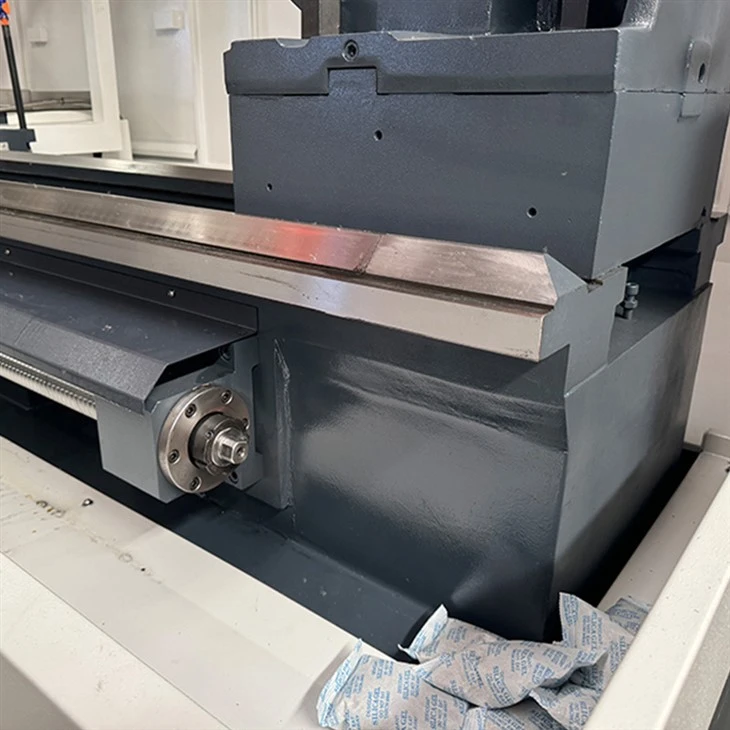
Another factor that impacts maximum spindle power is the machine's frame and construction. A large CNC horizontal lathe with a cast iron frame will absorb vibration far better than a welded steel frame, allowing it to deliver its maximum power consistently, without slip or deflection. This is especially true when you're running at peak power for long periods; a rigid frame prevents spindle drift, which keeps cuts accurate and tool life longer. Our Flat Bed CNC Lathe line, for example, uses a heavy cast iron bed that supports high‑power spindles while maintaining precision even on parts over 10 feet long.
Let's talk about what happens when you exceed a spindle's maximum power for an extended period. Running a spindle beyond its rated continuous power leads to overheating, which causes the spindle's bearings to wear out prematurely, reduces cutting accuracy, and can lead to costly downtime. It's not just bad for the machine-it's bad for your parts. Overheated spindles can cause thermal expansion, which means your cuts won't hold tight tolerances, a big problem for aerospace or automotive parts that need to fit perfectly. That's why it's always better to size your spindle power slightly above your current needs, rather than exactly meeting them, leaving room for future work or more demanding materials.
I've seen customers come to us who upgraded from a smaller lathe with 50kW spindle power to a large horizontal lathe with 150kW continuous power, and the difference in productivity was dramatic. A job that used to take 8 hours on their old machine took 3 hours on the new one, because they could take larger cuts at full power, without stopping to slow down or reduce the depth of cut. For high‑volume production, that kind of speed adds up to thousands of parts per month, translating to real bottom‑line savings.
But maximum spindle power isn't the only spec to consider. You also need to think about spindle size, bearing type, cooling system, and control software. A high‑power spindle without proper cooling will overheat quickly, so most large horizontal lathes use a closed‑loop oil cooling system that maintains consistent spindle temperature during long runs. That's why we design our machines with advanced cooling systems, paired with the right spindle gearings, to deliver maximum power reliably, shift after shift.
If you're in the market for a large‑scale CNC horizontal lathe, here's a practical tip: don't just look at the advertised maximum spindle power number. Ask the supplier for the continuous power rating at low RPM, where you'll actually be doing most of your heavy work. Advertised peak power numbers are often for short, one‑time bursts, while continuous power is what matters for 90% of your production runs. For example, a machine with 150kW continuous power and 220kW peak power is far more useful for roughing large steel parts than a machine with 200kW peak power and only 100kW continuous power.
Another point to keep in mind: some suppliers advertise "spindle power" that's actually the motor power, not the power delivered to the cutting tool. Motor power is the power going into the spindle, but gear losses, bearing friction, and other factors mean the power that actually reaches the tool is slightly lower. A reputable supplier will list the spindle's output power, not just the motor's input power, which gives you a much clearer picture of what you can actually use in production.
As someone who's worked with CNC lathes for over a decade, I can tell you that maximum spindle power is a critical spec, but it's not the only one. It works in tandem with the machine's rigidity, torque delivery, and overall design. That's why we offer a range of large‑scale CNC horizontal lathes, from heavy‑duty turning units to multi‑tasking machines like our CNC Turn Mill Center Machine, so customers can pick the right spindle power and design for their specific needs. Whether you're turning large shafts, flanges, or industrial components, choosing a machine with the right maximum spindle power will help you get the job done faster, with better quality, and at lower cost.
If you're ready to learn more about which large‑scale CNC horizontal lathe is right for your production needs, or want to get a breakdown of spindle power specs for our full line of machines, don't hesitate to reach out to our team for a personalized consultation. We can walk you through torque curves, frame designs, and all the factors that go into choosing a machine that will grow with your business.
References
- Modern Machine Shop. (2022). "Spindle Power: What It Actually Means for Machining Productivity." Retrieved from industry machining publications database.
- Haas Automation. (2021). "Large Horizontal CNC Lathe Specifications and Application Guide." Internal industrial equipment technical documentation.
- American Machinist. (2020). "Key Considerations for Sizing CNC Lathe Spindles for Heavy Turning Operations." Manufacturing industry resource library.
- Okuma Corporation. (2023). "Heavy-Duty Horizontal Turning: Spindle Design and Performance Standards." Heavy industrial machinery technical reports.


