


Power consumption is a critical factor to consider when operating a traditional lathe. As a supplier of traditional lathes, I understand the importance of providing accurate information about power consumption to our customers. In this blog, I will delve into the various aspects of power consumption in traditional lathes, including the factors that influence it, how to calculate it, and ways to optimize it.
Factors Affecting Power Consumption
1. Motor Power Rating
The motor is the primary power - consuming component of a traditional lathe. The power rating of the motor, usually measured in horsepower (HP) or kilowatts (kW), plays a crucial role in determining the overall power consumption. A higher - rated motor consumes more power, but it also provides greater cutting force and speed. For example, a small bench - top lathe might have a motor with a power rating of 1 HP (about 0.75 kW), while a large industrial Large Lathe Machine could have a motor rated at 10 HP (about 7.5 kW) or more.
2. Cutting Parameters
The cutting parameters such as cutting speed, feed rate, and depth of cut significantly impact power consumption. When the cutting speed is increased, the lathe has to work harder to remove material, which leads to higher power consumption. Similarly, a larger depth of cut requires more force, and thus more power. For instance, if you are turning a large - diameter workpiece with a deep cut and high feed rate, the lathe will consume more power compared to a light - finishing operation.
3. Workpiece Material
The type of material being machined also affects power consumption. Harder materials like stainless steel or titanium require more cutting force than softer materials such as aluminum or brass. When machining a hard material, the lathe has to overcome greater resistance, which results in increased power usage.
4. Machine Efficiency
The overall efficiency of the lathe plays a role in power consumption. A well - maintained lathe with properly lubricated parts and aligned components will operate more efficiently and consume less power. On the other hand, a lathe with worn - out bearings, misaligned belts, or improper gear meshing will require more power to perform the same task.
Calculating Power Consumption
To calculate the power consumption of a traditional lathe, we need to consider the motor power and the time of operation. The basic formula for calculating energy consumption (E) is:
[E = P\times t]
where (P) is the power of the motor in kilowatts (kW) and (t) is the time of operation in hours.
For example, if a lathe has a motor with a power rating of 3 kW and it operates for 5 hours, the energy consumption will be:
[E=3\space kW\times5\space h = 15\space kWh]
However, this is a simplified calculation. In real - world scenarios, the actual power consumption may vary depending on the load on the motor. When the lathe is under a heavy load during cutting operations, the motor will draw more power, and during idle periods, it will draw less power.
Power Consumption in Different Types of Traditional Lathes
1. Bench - top Lathes
Bench - top lathes are typically used for small - scale machining operations, such as hobbyist work or light industrial applications. These lathes usually have relatively low - power motors, ranging from 0.5 to 2 HP (about 0.37 to 1.5 kW). Their power consumption is relatively low, making them suitable for operations with limited power availability.
2. Heavy - Duty Lathes
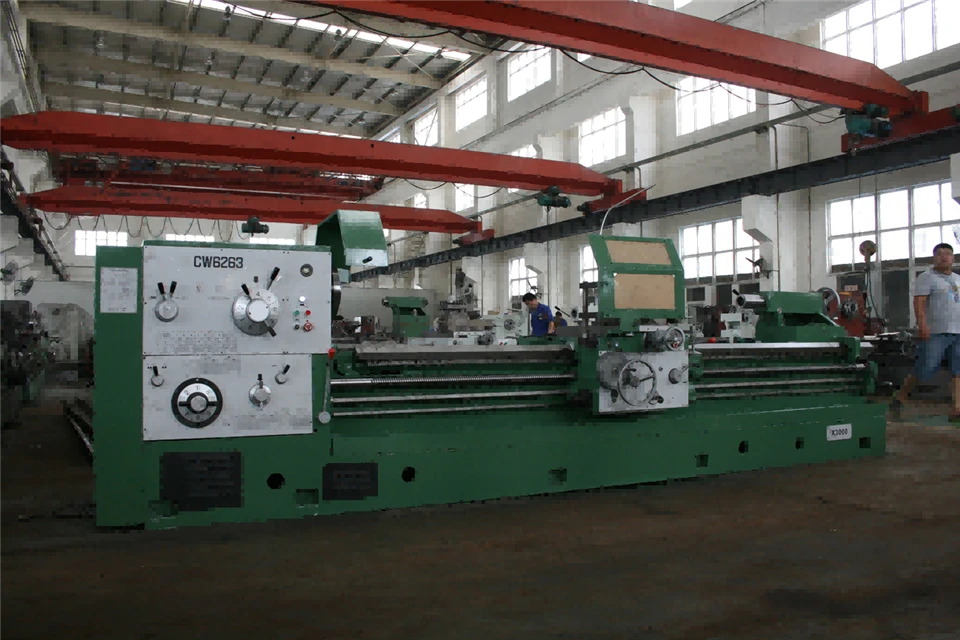
Heavy Duty Metal Lathe are designed for large - scale industrial applications, where they need to handle large workpieces and perform heavy - cutting operations. These lathes are equipped with high - power motors, often ranging from 5 to 20 HP (about 3.7 to 15 kW) or more. As a result, their power consumption is significantly higher compared to bench - top lathes.
3. Universal Lathes
Universal Lathe offer a wide range of machining capabilities and can be used for various types of workpieces and operations. Their power consumption depends on the specific model and the tasks they are performing. A medium - sized universal lathe may have a motor power rating of 3 - 7 HP (about 2.2 - 5.2 kW).
Optimizing Power Consumption
1. Proper Maintenance
Regular maintenance of the lathe is essential for optimizing power consumption. This includes lubricating the moving parts, checking and adjusting the belt tension, and ensuring proper alignment of the components. A well - maintained lathe will operate more efficiently, reducing the amount of power required to perform a given task.
2. Choosing the Right Cutting Parameters
Selecting the appropriate cutting parameters based on the workpiece material and the desired finish can significantly reduce power consumption. For example, using a lower cutting speed and feed rate when machining softer materials can save power while still achieving the required results.
3. Using Energy - Efficient Motors
Upgrading to energy - efficient motors can also help in reducing power consumption. These motors are designed to convert electrical energy into mechanical energy more efficiently, resulting in lower energy losses and reduced power consumption.
4. Idle Time Management
Minimizing the idle time of the lathe can also save power. When the lathe is not in use for a significant period, it should be turned off rather than left running in an idle state.
Real - World Examples
Let's consider a manufacturing company that uses a Extra Heavy Duty Lathe Machine to machine large - diameter steel shafts. The lathe has a 15 - HP (about 11.2 kW) motor and operates for 8 hours a day, 5 days a week.
If the lathe operates at full load for 60% of the time and at half - load for 30% of the time and is idle for 10% of the time, we can calculate the approximate power consumption as follows:
- Full - load power consumption per hour: (P_{full}=11.2\space kW)
- Half - load power consumption per hour: (P_{half}=11.2\space kW\times0.5 = 5.6\space kW)
- Idle power consumption per hour: Assume (P_{idle}=1\space kW)
The total power consumption per day is:
[E_{day}=(11.2\space kW\times0.6 + 5.6\space kW\times0.3+1\space kW\times0.1)\times8\space h]
[E_{day}=(6.72 + 1.68+0.1)\times8\space h]
[E_{day}=8.5\times8\space h=68\space kWh]
The total power consumption per week is (E_{week}=68\space kWh\times5 = 340\space kWh)
If the company implements power - saving measures such as optimizing cutting parameters, proper maintenance, and idle time management, they could potentially reduce the power consumption by 10 - 20%.
Importance of Understanding Power Consumption
Understanding the power consumption of a traditional lathe is crucial for several reasons. Firstly, it helps in cost - management. By knowing how much power the lathe consumes, manufacturers can accurately estimate the energy costs associated with their machining operations. Secondly, it contributes to environmental sustainability. By optimizing power consumption, companies can reduce their carbon footprint and contribute to a more sustainable manufacturing industry.
Contact for Procurement
If you are in the market for a traditional lathe and are concerned about power consumption, we are here to help. As a leading supplier of traditional lathes, we offer a wide range of Universal Lathe Stand and machines, including bench - top lathes, heavy - duty lathes, and universal lathes. Our team of experts can assist you in selecting the right lathe for your specific requirements and provide guidance on optimizing its power consumption.
Contact us to start a discussion about your procurement needs. We look forward to working with you to find the most suitable lathe solution for your business.
References
- ASM Handbook, Volume 16: Machining, ASM International
- Manufacturing Engineering and Technology, by Serope Kalpakjian and Steven Schmid
- Machinery's Handbook, Industrial Press Inc.


