


Hey there! As a supplier of Universal Lathes, I often get asked about the programming languages used for CNC Universal Lathes. It's a pretty hot topic, especially in the manufacturing world where precision and efficiency are key. So, let's dive right in and explore what programming languages are commonly used in these machines.
G - Code: The Old Reliable
First up, we've got G - Code. It's like the granddaddy of CNC programming languages. G - Code has been around for ages, and it's still the most widely used language for CNC Universal Lathes. Why? Well, it's simple, really. G - Code uses a series of commands that tell the lathe what to do, like moving the tool in a certain direction, setting the spindle speed, or controlling the coolant.
For example, a basic G - Code program might look something like this:
N10 G20 ; Set units to inches
N20 S500 M03 ; Set spindle speed to 500 RPM and start it in the forward direction
N30 G00 X1.0 Z0.5 ; Rapid move the tool to X = 1.0 inch and Z = 0.5 inch
N40 G01 X0.5 F0.01 ; Feed the tool to X = 0.5 inch at a feed rate of 0.01 inches per revolution
This code sets the units, starts the spindle, moves the tool to a specific position, and then performs a cutting operation. G - Code is great because it's easy to understand and most CNC Universal Lathes support it out of the box. If you're new to CNC programming, G - Code is a great place to start.
M - Code: The Helper
While G - Code is used for controlling the movement of the tool, M - Code is used for controlling the auxiliary functions of the lathe. Things like turning on the coolant, changing the tool, or stopping the spindle. M - Code is usually used in conjunction with G - Code to create a complete program.
For example, the M03 command we saw earlier starts the spindle in the forward direction, while M05 stops it. M08 turns on the coolant, and M09 turns it off. M - Code adds an extra layer of control to your CNC Universal Lathe, making it more versatile.
Advanced Programming Languages
But G - Code and M - Code aren't the only games in town. There are also some more advanced programming languages that can be used for CNC Universal Lathes. One of these is Fanuc Ladder Logic. Fanuc is a well - known manufacturer of CNC systems, and their Ladder Logic allows you to create more complex programs with conditional statements and loops.
Another option is Siemens ShopMill/ShopTurn. Siemens is another big player in the CNC world, and their programming languages are designed to be more user - friendly and intuitive. They allow you to create programs using graphical interfaces, which can be a real time - saver for experienced programmers.
Choosing the Right Language
So, how do you choose the right programming language for your CNC Universal Lathe? Well, it depends on a few factors. If you're just starting out, G - Code is probably your best bet. It's easy to learn and widely supported. If you're working with a specific brand of CNC system, like Fanuc or Siemens, it might make sense to learn their proprietary programming languages.
Also, consider the complexity of your projects. If you're doing simple turning operations, G - Code and M - Code will probably be enough. But if you're working on more complex parts with multiple operations and conditional logic, you might need to step up to a more advanced language.
Our Universal Lathes and Programming
At our company, we offer a range of Universal Lathes, including the Heavy Duty Metal Lathe, the Lathe Machine 8 Feet, and the Traditional Lathe. All of our lathes are designed to be compatible with G - Code and M - Code, so you can start programming right away.
We also provide training and support to help you get the most out of your CNC Universal Lathe. Whether you're a beginner or an experienced programmer, our team is here to assist you.
Why Programming Matters
Programming is the heart and soul of a CNC Universal Lathe. It's what allows you to create precise, repeatable parts with minimal human intervention. With the right programming language, you can optimize your production process, reduce waste, and increase efficiency.
Imagine being able to program a lathe to produce hundreds of identical parts with the same level of accuracy every time. That's the power of CNC programming. And with our Universal Lathes, you have the tools to make it happen.

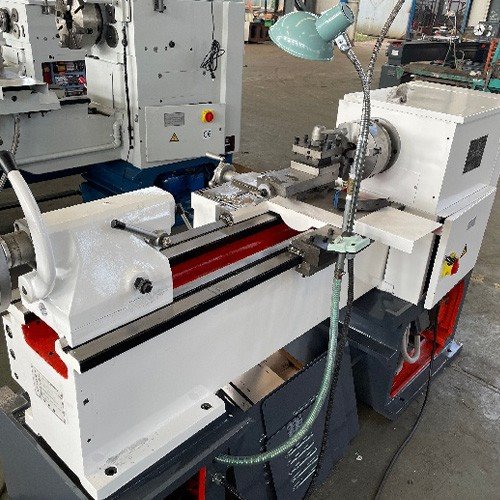
Contact Us for Your CNC Universal Lathe Needs
If you're in the market for a CNC Universal Lathe or want to learn more about programming languages, we'd love to hear from you. Whether you're a small - scale manufacturer or a large industrial operation, we have the right lathe for you.
Contact us today to discuss your requirements and start the process of getting the perfect CNC Universal Lathe for your business. We're here to help you take your manufacturing to the next level.
References
- "CNC Programming Handbook" by Dan Holtz
- "Introduction to CNC Machining" by John Doe
- Fanuc and Siemens official documentation


