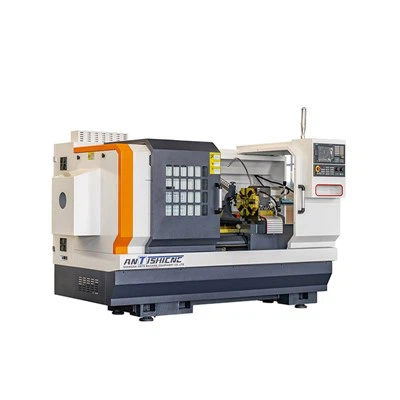
When it comes to large lathe machines, one of the crucial components that significantly impacts the machine's functionality and versatility is the spindle nose. As a leading supplier of large lathe machines, we understand the importance of different spindle nose types and how they can meet various machining requirements. In this blog post, we will explore the different types of spindle noses found on large lathe machines, their features, and applications.
Morse Taper Spindle Nose
The Morse taper spindle nose is one of the most common types found on lathe machines, including large ones. It is named after Stephen A. Morse, who patented it in 1864. The Morse taper has a self - holding design, which means it can hold tools or workpieces firmly without the need for additional clamping in most cases.
The Morse taper comes in different sizes, such as MT1, MT2, MT3, etc. Larger lathes typically use larger Morse tapers, like MT4, MT5, or MT6. For example, a Lathe Machine 8 Feet might be equipped with an MT5 or MT6 spindle nose. This type of spindle nose is ideal for mounting drill chucks, centers, and other tools that have a corresponding Morse taper shank. It is widely used in general machining operations, such as turning, drilling, and reaming.
Camlock Spindle Nose
Camlock spindle noses are known for their quick - change capabilities. They use a cam - locking mechanism to secure the tool or workpiece in place. This allows for rapid tool changes, which can significantly reduce setup time in a production environment.
The camlock system consists of a cam ring that, when rotated, locks or unlocks the tool against the spindle nose. This type of spindle nose is often used in high - volume production settings where time is of the essence. Our Extra Heavy Duty Lathe Machine can be equipped with a camlock spindle nose to enhance productivity. It is suitable for applications where multiple tools need to be used in a short period, such as in mass - producing small to medium - sized parts.
D1 - Series Spindle Nose
The D1 - series spindle nose is a standard type used in many large lathe machines. It has a specific flange and thread configuration that allows for the attachment of chucks and other work - holding devices. The D1 - series is designed to provide a secure and rigid connection between the spindle and the chuck, ensuring accurate machining.
The D1 - series comes in different sizes, such as D1 - 4, D1 - 5, D1 - 6, etc. Larger lathes usually use larger D1 sizes. For instance, a large - scale Traditional Lathe might be fitted with a D1 - 6 or D1 - 8 spindle nose. This type of spindle nose is commonly used in industries where high - precision turning is required, such as in the aerospace and automotive sectors.
J - Series Spindle Nose
The J - series spindle nose is another type that is commonly found on large lathe machines. It is similar to the D1 - series in terms of its function of holding chucks and work - holding devices. However, the J - series has a different flange and thread design.
The J - series is known for its robustness and ability to handle heavy - duty machining operations. It provides a stable platform for large chucks and workpieces, making it suitable for machining large - diameter and heavy parts. Our large lathe machines can be customized with J - series spindle noses to meet the specific needs of customers in industries such as shipbuilding and heavy machinery manufacturing.
Threaded Spindle Nose
A threaded spindle nose is a simple yet effective design. It has external threads on the spindle, which can be used to attach chucks, faceplates, and other accessories. This type of spindle nose is relatively easy to use and is suitable for basic machining operations.
However, it may not provide the same level of precision and rigidity as some of the other types, especially in high - speed or heavy - duty applications. Nevertheless, for small - scale workshops or for simple turning jobs, a threaded spindle nose on a large lathe machine can be a cost - effective option.

Selecting the Right Spindle Nose
When selecting a large lathe machine, choosing the right spindle nose is crucial. Several factors need to be considered:
- Machining Requirements: If you are mainly involved in high - volume production, a camlock spindle nose might be the best choice due to its quick - change capabilities. On the other hand, if you need high - precision machining, a D1 - series or J - series spindle nose would be more suitable.
- Tool Compatibility: Ensure that the spindle nose is compatible with the tools and work - holding devices you plan to use. For example, if you have a collection of Morse taper - shank tools, a Morse taper spindle nose would be a good option.
- Workpiece Size and Weight: For large and heavy workpieces, a spindle nose with high rigidity, such as the J - series, is necessary to ensure stable machining.
As a supplier of large lathe machines, we have a wide range of options available to meet different customer needs. Our team of experts can help you select the most appropriate spindle nose type based on your specific requirements. Whether you are a small - scale workshop or a large - scale manufacturing plant, we can provide you with the right solution.
If you are interested in purchasing a large lathe machine or have any questions about spindle nose types, please feel free to contact us. We are more than happy to assist you in making the best decision for your machining needs.
References
- "Machinery's Handbook", Industrial Press Inc.
- "Lathe Operations Manual", Various manufacturers' manuals.