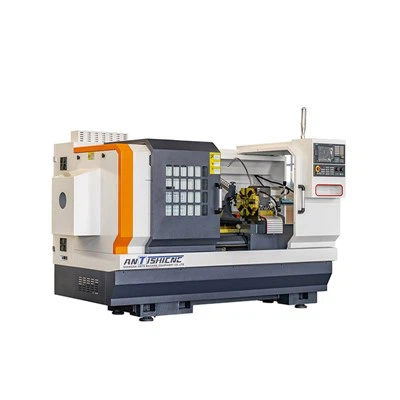
Hey there! As a supplier of Flat Bed Lathes, I often get asked if a flat bed lathe can be used for threading different pitch sizes. Well, the short answer is yes, but there's a bit more to it than that.
First off, let's talk about what a flat bed lathe is. A flat bed lathe is a type of lathe machine that has a flat bed structure. It's a versatile piece of equipment that can be used for a variety of machining operations, including turning, facing, boring, and of course, threading.
When it comes to threading, a flat bed lathe is quite capable of handling different pitch sizes. The pitch of a thread refers to the distance between adjacent threads. Different applications require different thread pitches, and a good flat bed lathe can be adjusted to accommodate these variations.
One of the key features that allows a flat bed lathe to thread different pitch sizes is its gearbox. The gearbox in a flat bed lathe provides a range of gear ratios, which can be used to control the speed and feed rate of the cutting tool. By changing the gear ratio, you can adjust the pitch of the thread being cut.
For example, if you need to cut a fine pitch thread, you can select a higher gear ratio, which will slow down the rotation of the workpiece and allow the cutting tool to make more precise cuts. On the other hand, if you need to cut a coarse pitch thread, you can choose a lower gear ratio, which will increase the speed of the workpiece and the cutting tool.
Another important factor is the lead screw. The lead screw in a flat bed lathe is responsible for moving the carriage along the bed of the lathe. It's directly connected to the spindle, and its rotation determines the pitch of the thread being cut. By changing the lead screw or using different gears on the lead screw, you can change the pitch of the thread.
Some modern flat bed lathes, like the Flat Bed CNC Lathe Machine, come with advanced control systems that make it even easier to thread different pitch sizes. These CNC (Computer Numerical Control) lathes allow you to program the desired thread pitch and other parameters directly into the machine. The machine then automatically adjusts the speed, feed rate, and other settings to cut the thread accurately.
Let's take a look at the process of threading different pitch sizes on a flat bed lathe. First, you need to select the appropriate cutting tool. The cutting tool should be sharp and have the correct shape for the type of thread you want to cut. Then, you need to set up the lathe by adjusting the gear ratio and the lead screw.
Once the lathe is set up, you can start the threading process. You'll need to position the cutting tool at the starting point of the thread and engage the feed mechanism. As the workpiece rotates, the cutting tool will move along the workpiece, cutting the thread. You'll need to monitor the process closely to ensure that the thread is being cut accurately.


It's important to note that threading different pitch sizes requires some skill and experience. You need to have a good understanding of the lathe's operation and the principles of threading. If you're new to threading, it's a good idea to practice on some scrap material before working on a real project.
Now, let's talk about some of the advantages of using a flat bed lathe for threading different pitch sizes. One of the main advantages is its versatility. A flat bed lathe can be used to thread a wide range of materials, including metals, plastics, and wood. It can also handle different thread forms, such as metric, imperial, and acme threads.
Another advantage is its accuracy. With the right setup and technique, a flat bed lathe can cut threads with a high degree of precision. This is important for applications where tight tolerances are required, such as in the aerospace and automotive industries.
In addition, flat bed lathes are relatively easy to operate and maintain. They have a simple design and are made of durable materials, which makes them reliable and long-lasting.
However, there are also some limitations to using a flat bed lathe for threading different pitch sizes. One of the limitations is the maximum pitch that the lathe can handle. Some flat bed lathes may have a limited range of pitch sizes that they can cut. If you need to cut very fine or very coarse pitch threads, you may need to use a different type of lathe or a specialized threading machine.
Another limitation is the speed of the threading process. Threading can be a time-consuming operation, especially when cutting fine pitch threads. If you need to produce a large number of threaded parts in a short period of time, you may need to consider using a more automated or high-speed threading machine.
In conclusion, a flat bed lathe can definitely be used for threading different pitch sizes. It's a versatile and accurate machine that can handle a wide range of threading applications. Whether you're a hobbyist or a professional machinist, a flat bed lathe can be a valuable addition to your workshop.
If you're interested in purchasing a flat bed lathe or have any questions about threading different pitch sizes, feel free to reach out to us. We're a leading supplier of CNC Turn Mill Center Machine, Flat Bed CNC Lathe Machine, and Fanuc CNC Lathe. We have a team of experts who can help you choose the right machine for your needs and provide you with the support and training you need to get the most out of your lathe.
References:
- "Machining Handbook" by Industrial Press
- "Lathe Operations" by various industry publications