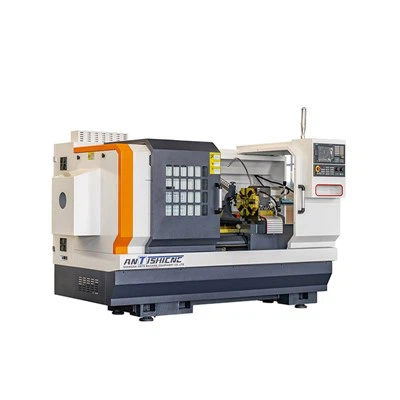
What kind of tooling is used in a cnc swiss lathe?
In the world of precision manufacturing, CNC Swiss lathes stand out as indispensable machines, renowned for their ability to produce high - precision, complex parts. As a dedicated CNC Swiss lathe supplier, I have extensive experience with the tooling used in these remarkable machines. In this blog, we will explore the various types of tooling involved in a CNC Swiss lathe and how they contribute to the overall machining process.
Turning Tools
Turning is one of the fundamental operations performed on a CNC Swiss lathe. Turning tools are designed to remove material from the outer diameter of the workpiece, shaping it to the desired dimensions. There are several types of turning tools commonly used.
Roughing Tools: These tools are used at the beginning of the turning process to quickly remove large amounts of material. They typically have a larger cutting edge and a more aggressive geometry, which allows for high - material - removal rates. However, the surface finish produced by roughing tools is relatively rough, and further machining is required to achieve the desired precision and smoothness.
Finishing Tools: Once the roughing is complete, finishing tools come into play. These tools have a finer cutting edge and are designed to create a smooth surface finish and precise dimensions. They remove a small amount of material in each pass, ensuring that the final part meets the required tolerances. For instance, in the production of medical components, where surface finish and dimensional accuracy are critical, finishing tools play a crucial role.
Boring Tools
Boring is the process of enlarging an existing hole in a workpiece or creating an internal cylindrical shape. Boring tools used in CNC Swiss lathes are highly specialized. They need to be able to reach deep into the workpiece while maintaining stability and precision.


Single - Point Boring Bars: These are the most common type of boring tools. A single - point cutting edge is used to remove material from the inside of the hole. The design of the boring bar is crucial, as it must be rigid enough to prevent vibration. If the boring bar vibrates during the cutting process, it can lead to poor surface finish and inaccurate hole dimensions. For example, when machining aerospace components with tight tolerances for internal holes, single - point boring bars are carefully selected and optimized.
Multi - Edge Boring Tools: These tools have multiple cutting edges, which can increase the material - removal rate and improve the efficiency of the boring process. They are especially useful when machining larger holes or when a high - throughput production is required.
Drilling Tools
Drilling is used to create holes in the workpiece. In a CNC Swiss lathe, drilling tools need to be precise and reliable.
Twist Drills: Twist drills are the most commonly used drilling tools. They have a helical flute design that helps to carry the chips away from the cutting area. The geometry of the twist drill, such as the point angle and helix angle, affects the cutting performance. For general - purpose drilling in a variety of materials, twist drills are a popular choice.
Gun Drills: Gun drills are used for deep - hole drilling applications. They are designed to drill holes with a high length - to - diameter ratio, such as those required in automotive engine components. Gun drills use a single cutting edge and a coolant - through design to flush out the chips and keep the cutting edge cool.
Threading Tools
Threading is the process of creating threads on the workpiece, either externally or internally. Threading tools in a CNC Swiss lathe need to be able to produce accurate and high - quality threads.
External Threading Inserts: These inserts are used to create external threads on the outer diameter of the workpiece. They come in various thread profiles, such as metric, unified, and acme threads. The geometry of the insert is carefully designed to ensure the correct pitch and thread form.
Internal Threading Tools: For creating internal threads, special internal threading tools are used. They need to be smaller in size and more flexible to reach the inside of the hole. Just like external threading, the correct selection of internal threading tools is essential to produce threads with the desired quality.
Milling Tools
Although CNC Swiss lathes are primarily turning machines, milling operations can also be performed with the use of appropriate tooling.
End Mills: End mills are used for milling flat surfaces, slots, and pockets. They have cutting edges on the end and the sides, allowing for both axial and radial cutting. In a CNC Swiss lathe, end mills can be used to add features such as keyways or flats to the turned parts.
Ball Nose End Mills: These mills have a rounded end, which makes them suitable for machining curved surfaces and contours. They are commonly used in the production of complex parts, like mold components, where smooth arcs and curves are required.
The Importance of Tool Selection
Selecting the right tooling for a CNC Swiss lathe is crucial for several reasons. Firstly, it directly affects the quality of the finished part. Using the wrong tool can result in poor surface finish, inaccurate dimensions, and even tool breakage. Secondly, tool selection impacts the efficiency of the machining process. The right tools can increase the material - removal rate, reduce cycle times, and improve overall productivity. For example, choosing a high - performance cutting tool can allow for higher cutting speeds and feeds, which means more parts can be produced in a shorter period.
Moreover, different materials require different types of tooling. For example, machining aluminum requires a different type of tool than machining hardened steel. Aluminum is a soft material, so tools with a sharp cutting edge and a high chip - evacuation rate are preferred. On the other hand, hardened steel is a much tougher material, and tools with high - wear resistance and a strong cutting edge are needed.
Tool Management in a CNC Swiss Lathe
Proper tool management is essential for the smooth operation of a CNC Swiss lathe. This includes tool storage, tool setting, and tool monitoring. Tools should be stored in a clean and organized environment to prevent damage. Regular tool inspections are necessary to detect any signs of wear or damage.
Tool setting is a critical process that determines the accuracy of the machining operation. Precise tool setting ensures that the cutting tool is positioned correctly relative to the workpiece. In modern CNC Swiss lathes, automatic tool - setting systems are often used to improve the accuracy and efficiency of the setting process.
Tool monitoring systems can also be employed to detect tool wear and breakage in real - time. These systems use sensors to monitor parameters such as cutting force, vibration, and temperature. When a tool starts to wear or breaks, the system can send an alarm to the operator, allowing for timely tool replacement.
Conclusion
In summary, CNC Swiss lathes utilize a wide range of tooling, including turning tools, boring tools, drilling tools, threading tools, and milling tools. Each type of tool has its specific function and is designed to meet the demands of different machining operations. As a CNC Swiss lathe supplier, we understand the importance of providing high - quality tooling solutions to our customers. Whether you are interested in a Swiss Type Lathe Machine, a Swiss Style Lathe, or a CNC Swiss Lathe Machine, we can offer you the expertise and support you need.
If you are looking to enhance your precision - manufacturing capabilities or have any questions regarding CNC Swiss lathe tooling, please feel free to contact us for a detailed discussion. We are commitment to providing you with the best solutions to meet your production needs.
References
- "Manufacturing Engineering & Technology" by Serope Kalpakjian and Steven Schmid
- "CNC Programming Handbook" by Peter Smid